
Social media strategy: how to build one step by step, with a template.
A social media strategy sets what your channels should do for the business, who you post for, where, what and how often, and how you measure success. After this guide you have your strategy on one page, with a template to fill in. You choose channels with current usage figures for Switzerland and Germany instead of gut feeling.
- Author
 LaraSocial media management and strategy, community online and offline
- Published
- Updated
- Reading time
- 11 minutes

In short
- A social media strategy answers six questions: why you post, for whom, on which channels, with which formats, how often, and how you know it works.
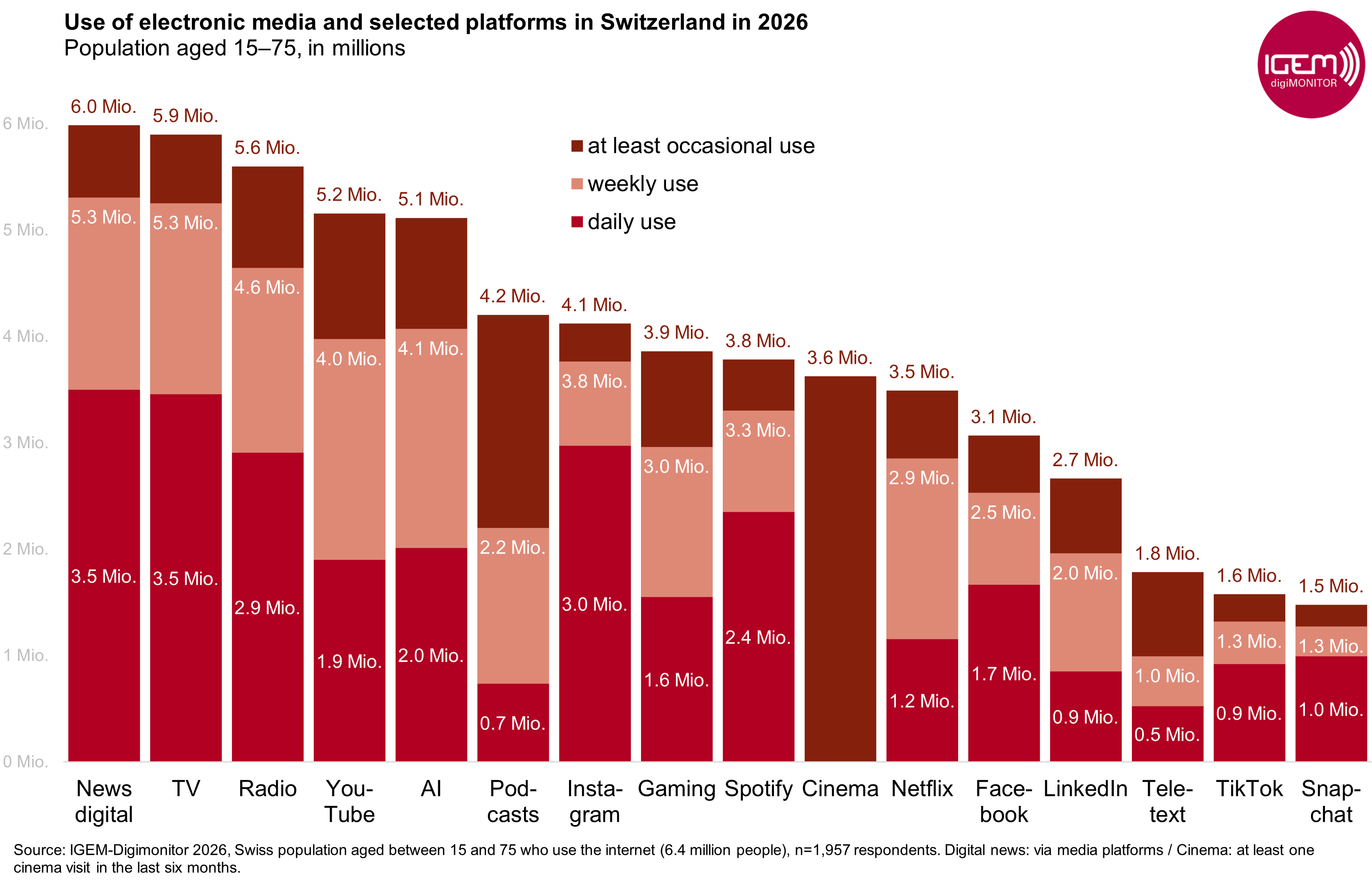
- Choose channels by audience: in Switzerland, 3.8 million people aged 15 to 75 use Instagram at least weekly, and 2.0 million use LinkedIn [1].
- Plan only as many channels as you can reliably fill with content every week.
- Measure business results, not just likes: with UTM parameters on your links, Google Analytics shows which visits came from which channel and campaign [10].
Many businesses post because that is what you do. After a few months comes the question that keeps showing up in forums: we post so much, why does nobody react? Usually what is missing is not a better photo but a decision about what the channel is for.
Here you build your social media strategy in six steps, from the goal to the review. At the end is a template that fits on one page. It works for an online store, a hotel or a medical practice just as well as for a B2B company.
01What a social media strategy is, and what a content calendar is
- Strategy
- Why, for whom, where, how often
- Content calendar
- What goes out on which day
- Length
- One page is enough
A social media strategy is the decision about what your channels should do for the business and how you get there. It answers six questions: goal, audience, channels, formats, cadence and measurement. It rarely changes. You look at it once a quarter.
The content calendar is the tool underneath. It says which post goes out on which day on which channel, who makes it and who approves it. It changes every week. A social media plan or concept usually means both together, often as a document for management.
The order matters. Start with the calendar and you fill gaps in a schedule. Start with the strategy and you fill the schedule with posts that serve a goal. One page is enough. The template is at the end of this guide.
02Step 1: Derive your social media goals from your business goals
- Question
- What should social media do for the business?
- Form
- Measurable, with a deadline
- Number
- One main goal, two side goals at most
Start with the business, not the platform. An online store needs sales, a practice needs new patients, a B2B company needs conversations with decision makers, a new brand needs attention. Turn that into a social media goal you can measure and that has a deadline. The SMART formula helps: specific, measurable, achievable, relevant and time-bound.
| Business goal | Social media goal | How you measure it |
|---|---|---|
| More revenue in the store | More visits from Instagram to product pages | Sessions and sales from links with UTM parameters |
| New local customers | More enquiries via profile and website | Messages, calls, forms |
| Become better known | Reach more people in the target group | Reach and new followers |
| Find people for the team | Applications via LinkedIn | Clicks to the jobs page |
Set one main goal and two side goals at most. If you want everything at once, you get posts that speak to nobody in particular. Write the goal as a sentence, for example: “By the end of June, twice as many visits come from Instagram to the store as today.” Take the baseline from your own numbers, not from an industry average.
03Step 2: Define your audience, including age, language and region
- Question
- Who do you want to reach?
- Sources
- Orders, emails, reviews, comments
- Switzerland
- Plan for the language region
Describe the people who should buy from you or get in touch as precisely as you can. Four questions help: Who are they, by age, job and location? Which problem do you solve for them? What stops them from buying? And where do they spend time online? You find answers in orders, in customer emails, in reviews and in the comments on competitors’ posts.
Age often decides the channel. Among young people aged 12 to 19 in Switzerland, Instagram, TikTok, WhatsApp and Snapchat are the most popular social networks and messaging apps, regardless of age, gender or socio-demographic background. That is the finding of the JAMES study 2024, which ZHAW carries out every two years on behalf of Swisscom [2]. In Germany, 85% of 16 to 24 year olds actively used social media in 2025, compared with 25% of 65 to 74 year olds [3].
In Switzerland, language comes on top. If you want to reach French- or Italian-speaking Switzerland, you need posts in French or Italian, not just subtitles. Decide up front whether one channel runs in several languages or whether you run one channel per language. In B2B, describe the role, not just the company: a buyer looks for different answers than a managing director.
04Step 3: Choose your channels, with usage figures for Switzerland and Germany
- Switzerland
- IGEM-Digimonitor 2026
- Germany
- Destatis 2025, Bitkom 2026
- Rule of thumb
- One main channel, one more at most
Choose channels based on where your audience is and what you can deliver every week. For Switzerland, the IGEM-Digimonitor 2026 shows how many of the 6.4 million internet users aged 15 to 75 use a platform [1]:
| Platform | At least weekly | Daily |
|---|---|---|
| YouTube | 4.0 m | 1.9 m |
| 3.8 m | 3.0 m | |
| 2.5 m | 1.7 m | |
| 2.0 m | 0.9 m | |
| TikTok | 1.3 m | 0.9 m |
| Snapchat | 1.3 m | 1.0 m |
For Germany, official figures exist but are not split by platform. In 2025, 59% of 16 to 74 year olds actively used social media for private purposes, for example with their own account, their own posts or by interacting with others. Messaging apps do not count. The EU average was 67% [3]. Platform figures come from a telephone survey by the German digital association Bitkom in March and April 2026. Of the internet users aged 16 and over it surveyed, 85% use YouTube, 74% Facebook, 59% Instagram, 30% TikTok and 29% LinkedIn [4]. Bitkom only asks whether people use a platform, not how often, so the figures cannot be compared directly with the Swiss ones.
Before you choose, look at where you stand: which channels do you already have, which posts did well there, and where are two or three competitors active? Our rule of thumb: one main channel you deliver on every week, and one more at most. Instagram suits products, places and faces, LinkedIn suits B2B and hiring, TikTok suits brands that can keep delivering new videos. If you also want to run ads, read our comparison of where to start with paid advertising.
05Step 4: Set your content pillars and formats
- Pillars
- Three to four recurring topics
- Formats
- Reels, carousels, stories, statics
- AI content
- Plan the labelling
Content pillars are three to four topics you post about again and again. They make your social media content strategy plannable. For a small brand they could be: the product in everyday life, a look behind the scenes, useful knowledge for customers and voices of customers. Every post serves one pillar, and every pillar serves the goal.
Then come the formats. Reels and short videos reach new people, carousels explain step by step, stories keep followers close, statics carry an offer or one clear message. Videos by customers or creators show the product from a user’s point of view. What brands use such videos for is explained in our overview of content made by customers and creators, and what belongs in a good request to creators has its own guide.
If you work with AI images or AI videos, plan the labelling. In its Community Guidelines, effective from 24 September 2026, TikTok requires a label for AI-generated or significantly edited content that shows realistic-looking scenes or people [5]. Article 50 of the AI Act has applied in the EU since 2 August 2026. Deepfakes, meaning AI content that resembles real people, places or events and falsely appears authentic, must be disclosed clearly on first exposure at the latest. The duty falls on the business that uses the AI, and the European Commission gives an advertising company as an example [6]. Switzerland has no AI-specific legislation so far. In February 2025 the Federal Council asked for a consultation draft by the end of 2026, covering transparency among other things [7]. As of 28 October 2026, the Federal Council now plans to open the consultation in spring 2027 [8].
06Step 5: Cadence, content calendar and who does what
- Cadence
- What you can keep up for a quarter
- Roles
- Create, approve, reply
- Paid
- Boost good posts on purpose
How often you post depends less on a number from the internet than on what you can keep up for a quarter. A fixed number of posts per week that you actually deliver beats a plan that collapses after three weeks. Be honest about time: a reel with idea, shoot, edit and caption takes longer than a photo with two sentences.
For each post, the content calendar holds: date, channel, pillar, format, copy, who creates it and who approves it. Put launches, seasons and holidays in first, then fill the rest. Keep time free for replies, because comments and messages are part of the strategy. How that works day to day is covered in our guide on comments, moderation and meetups with your community.
Also decide how organic posts and ads work together. Posts that do well without budget are good candidates for an ad, because you already see that they land. If you need more videos with real people for that, read our guide on whether to look for creators yourselves or hand it off.
07Step 6: Measure success and adjust the strategy
- Monthly
- Short recap
- Quarterly
- Review the strategy
- Priority
- Business numbers before likes
Measure what fits your goal, and know the terms. On Instagram, reach counts the unique accounts that saw a post at least once. Views, by contrast, count every play [9]. For posts created after 2 July 2024, Meta no longer reports impressions in its API [9]. Saves and shares show whether a post was useful, profile visits and link clicks show whether it made people curious.
Whether social media brings sales or enquiries only shows on your website. Add UTM parameters to every link in your bio, stories or posts. According to Google, utm_source, utm_medium and utm_campaign should always be included [10]. Google Analytics 4 then shows how many visits came from which channel and which campaign [10].
Once a month, do a short recap: the three best posts, the three weakest and why. Once a quarter, review the strategy itself. Is the goal still right, does the channel fit, can you keep the cadence? Then change one thing, not everything at once, otherwise you won’t know what worked.
08Template: your social media strategy on one page
- Format
- A table to copy
- Who
- Everyone who posts or approves
- Review
- Once a quarter
Copy the table and answer the middle column. On the right is a made-up example for a small online jewellery brand.
| Building block | Your question | Example |
|---|---|---|
| Goal | What should social media deliver, by when? | Twice as many store visits from Instagram by the end of June |
| Metric | How do you measure it? | Sessions via UTM links and the sales from them |
| Audience | Who, which problem, which language? | Women aged 25 to 40 in German-speaking Switzerland, everyday jewellery |
| Channels | Main channel and one more at most | Instagram, TikTok as a test |
| Pillars | Three to four topics | Styling, making, care, customers |
| Formats | What shows each pillar best? | Reels, carousels, stories |
| Cadence | What can you keep up for a quarter? | Three posts a week, stories on weekdays |
| Roles | Who creates, approves, replies? | Owner approves, a team member replies daily |
| Ads | Which posts do you promote? | The two strongest reels of the month |
| Recap | When do you review? | Monthly in brief, the whole strategy quarterly |
From our work. With Lara looking after your channels on an ongoing basis, you get a strategy and content calendar, reels, stories, statics and UGC every week, community events online and offline, and a short recap every month. Or we show your team how to post better on its own.
Honest limits. We found no neutral source for how often a company should post, so we give no number. The Swiss figures come from a survey of 1,957 people, the German ones from official statistics and a Bitkom survey of 1,006 people [1][3][4]. Platforms often change rules and metrics, so check them before you start, and have legal questions checked by a professional if in doubt. You can write the strategy yourselves. Get help when nobody on the team has time to keep up the cadence.
Frequently asked questions
What goes into a social media strategy?
Six building blocks: a measurable goal with a deadline, a precisely described audience, one or two channels, three to four content pillars with matching formats, a cadence you can keep, and metrics with a fixed review. Add who creates posts, who approves them and who replies to comments. Together it fits on one page.
What is the difference between a social media strategy and a content calendar?
The strategy sets why, for whom, where and how often you post, and how you measure success. It rarely changes, so review it once a quarter. The content calendar puts it into practice. It says which post goes out on which day on which channel and who makes it. It changes every week.
How often should a business post on social media?
As often as you can manage in good quality for a whole quarter. There is no number that is right for every business. Start with a few posts a week on one channel and increase only once that runs smoothly. Also plan time for replying to comments and messages.
Is social media still worth it for small businesses?
Yes, if your customers are there and you have a clear goal. In Switzerland, 3.8 million people aged 15 to 75 use Instagram at least once a week [1]. For a small business, a well kept profile with a few good posts can be enough. Without a goal and a cadence, even a lot of posting achieves little.
How do I measure whether social media brings sales and not just likes?
Add UTM parameters to every link from social media, at least utm_source, utm_medium and utm_campaign [10]. Google Analytics then shows which visits came from which channel and campaign, and with ecommerce tracking set up, the sales from them too. For enquiries, also ask in your form how the person found you.
Sources
- IGEM and WEMF AG for Advertising Media Research (2026): IGEM-Digimonitor 2026: Use of electronic media and selected platforms in Switzerland in 2026 (chart). https://wemf.ch/media/mediennutzung_digimonitor_2026_e.png, retrieved 14 November 2026
- ZHAW and Swisscom (2024): JAMES study 2024: AI tools are taking over the daily lives of Switzerland’s youth. https://www.swisscom.ch/en/about/news/2024/11/28-james-studie.html, retrieved 14 November 2026
- Federal Statistical Office of Germany (Destatis) (2026): Press release N014 of 2 March 2026: 59% of people aged 16 to 74 in Germany actively use social media (German). https://www.destatis.de/DE/Presse/Pressemitteilungen/2026/03/PD26_N014_63.html, retrieved 14 November 2026
- Bitkom e. V. (2026): Social Media, Disinformation and Deepfakes: Bitkom Study Report 2026 (survey in weeks 12 to 17 of 2026, n = 1,006). https://www.bitkom.org/sites/main/files/2026-08/bitkom-study-report-social-media-and-disinformation-en.pdf, retrieved 14 November 2026
- TikTok (2026): Community Guidelines: Integrity and Authenticity (released 25 August 2026, effective 24 September 2026). https://www.tiktok.com/community-guidelines/en/integrity-authenticity, retrieved 14 November 2026
- European Commission (2026): Transparency obligations under Article 50 AI Act, FAQ (last update 24 July 2026). https://digital-strategy.ec.europa.eu/en/faqs/transparency-obligations-under-article-50-ai-act, retrieved 14 November 2026
- Swiss Federal Office of Justice (2025): Artificial intelligence, Federal Council decision of 12 February 2025 (German). https://www.bj.admin.ch/de/kuenstliche-intelligenz, retrieved 14 November 2026
- Swiss Federal Office of Communications (OFCOM) (2026): Federal Council takes note of interim progress on AI regulation (press release, 28.10.2026). https://www.bakom.admin.ch/en/newnsb/s2TQiUUjrA5D, retrieved 14 November 2026
- Meta for Developers (n.d.): Instagram Media Insights (metrics reach, views, impressions). https://developers.facebook.com/docs/instagram-platform/reference/instagram-media/insights, retrieved 14 November 2026
- Google (n.d.): Analytics Help: URL builders: Collect campaign data with custom URLs. https://support.google.com/analytics/answer/10917952?hl=en, retrieved 14 November 2026
This guide is by nalu studios. We offer the service it covers ourselves. AI helps us work, a human has the final say. How we work: About us and our values.